Showing posts with label Persimmon. Show all posts

Tuesday, May 26, 2009

Blackberries

blackberries start to produce tiny fruits


Saturday, May 16, 2009

Multiple-Budded Fruit Tree: Peach, Plum, Nectarine

Most of the multi-budded fruit tree is peach, apricot, nectarine, or pear...My father-in-law once grafted multiple types of apple in one tree. I guess this is a new generation of multiple-budded cocktail fruit tree with plum, peach, and nectarine combination, please see (1) & (2) photos. The fruits are getting larger; some branches grow to different heights with dominant leaders on one side. Right now it is 6' tall; it probably needs pruning during fall season to keep the tree small and manageable.

So, what to do when pruning the fruit tree next time? Don't throw the branch away, try the drafting or budding technique, who knows probably miracle will happen ;-)


Useful links:
University of Missouri grafting technique (this is the best one)

http://extension.missouri.edu/publications/DisplayPub.aspx?P=G6971
According to Rothenberger and Starbuck @ UM, most varieties of a particular fruit or flowering species are interchangeable and can be grafted. Grafting techniques can be divided into two basic types, which are largely determined by the size of the understock. In some cases, a graft may be made to join a scion and understock of nearly equal size. The other type attaches a small scion to a much larger understock. In this case, several scions may be attached to the understock as in cleft or bark grafting.
Materials needed:
  • Knife
  • Grafting wax - After the graft is made, some covering must be used to keep it from drying out.
  • Grafting tape - A special tape with a cloth backing that decomposes before girdling can occur. Tapes may be used for binding grafts where there is not enough natural pressure. Electrical and masking tapes are also
  • Budding strips are elastic bands. They look like a wide rubber band that has been cut open.
  • Nails - Veneer, bridge and inarching grafts require long, thin nails.
  • Grafting tool- a blade used to split the stub and a wedge to hold the split open while the scions are inserted.
*** If you find other grafting or budding techniques and would like to share to all readers/gardeners, please post a comment. I'm happy to invite anyone who would like to leave message and share :-)

North Carolina State University: Grafting and Budding Nursery Crop Plants

http://www.ces.ncsu.edu/depts/hort/hil/ag396.html

Cornell University: Grafting and Budding

http://instruct1.cit.cornell.edu/courses/hort494/mg/reasons/ReasonsGBLeft.html

Grafting Method From Wikipedia: Approach grafting or inarching is used to join plants that are otherwise difficult to join. The plants are grown close together, and then joined so that each plant has roots below and growth above the point of union. Both scion and stock retain their respective parents that may or may not be removed after joining. Also used in pleaching. The graft can be successfully accomplished any time of year.

How To Plant A Multiple-Budded Fruit Tree
(Video)

How to prune a 4 in 1 plum tree - California Gardening Forum

Fruit Trees: Training and Pruning Deciduous Trees http://homeorchard.ucdavis.edu/8057.pdf


Nursery: List of multi-budded fruit trees
Custom budding and contract growing

Wednesday, May 13, 2009

Diospyros Kaki Fuyu Persimmon Tree

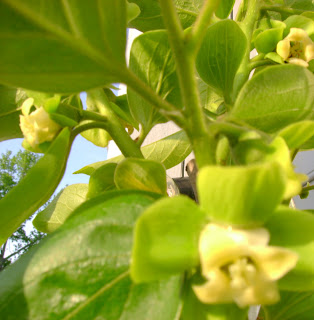
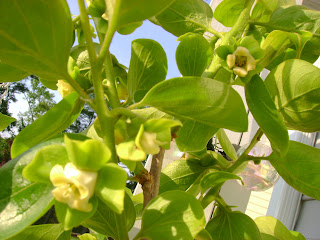
This new Fuyu persimmon tree had already blossomed when I bought it. It is a replacement for the dead Nectarine tree (see here). The reason I pick another persimmon tree is because Persimmon can adapt to a wide range of soils and climates, and it's immune from most disease and insects (at least less maintenance than Nectarine tree). The leaves are glossy and leathery and may be yellow or reddish-purple in the fall. Persimmon flowers look like bell-shaped with creamy to greenish-yellow, fragrant, usually with 4 thick, recurved lobes and staminate flowers in 2-3-flowered clusters. It flowers in March-June and fruits in September-November. Small fruit is greenish to yellowish with highly astringent pulp before ripening, turning yellowish-orange to reddish-orange and sweet in the fall.

The Fuyu species are almost seedless. The wood of persimmon is hard, smooth, and even textured. Asian remedy uses unripe fruit and inner bark has been used in the treatment of fever, diarrhea, and hemorrhage. The fruits are used in puddings, cookies, cakes, custard, and sherbet; the dried, roasted, ground seeds have been used as a substitute for coffee.

Persimmon tree can tolerate hot, dry, poor soils, including various city conditions, but moist and well-drained soils provide best conditions. The most important is plant it in well-drained soil, one of my trees die due to poor drainage.

It is a long life tree; some trees have been reported to reach 150 years of age. Good fruit crops are borne every 2 years. Persimmon is slow growing and tree is usually not very large size. The tree sends down a deep taproot, which makes it a good species for erosion control but makes it difficult to transplant.

Most of the fruit trees will encounter some types of disease. So, watch out for the webworm and hickory horned devil that caused the diseases on persimmon tree. An infected tree lives 1-2 years after the wilting appears. Small branches severed by a twig girdler are often encountered; the wounds allow entry of a wilt fungus Cephalosporium Diospyri that can kill the persimmon tree. Like most of the fruit trees, persimmon tree also attract animals. Leaves and twigs of common persimmon are eaten in fall and winter by white-tailed deer. The fruit is eaten by various birds, deer, and other wild life.



Need to dig a bigger hole
Miracle-Gro® soil - with bad smell


Interesting readings:

http://www.seedtosupper.com/persimmons.html

Persimmon Fruits Fact
http://www.crfg.org/pubs/ff/persimmon.html

WHY FRUIT TREES ARE GRAFTED?
http://www.midfex.org/m/whygraft.html

Tuesday, April 28, 2009

Amazing One-Tree Orchard! Persimmon Dwarf Cocktail Fruit Tree

Three varieties from this unusual fruit cocktail tree - it is persimmons, nectarines, and peaches all from the same tree. Possible it's three separate varieties grafted onto one rootstock. It's self-pollinating and grows about 7 feet tall. I can reach fruits from this little one tree orchard standing right on the ground. It's especially nice when someone doesn't have room for an orchard, a spectacular sight to enjoy.


Fruit Cocktail Tree Discussion
Cocktail Tree Discussion 2
Producing a Multi-Grafted Tree

Tuesday, March 10, 2009

Multi-budded fruit tree blossom

I ordered a new Fuyu persimmon tree from online nursery, it has blossomed this week.
I found out that the tree is bi-sexual :D and multi-budded.
A bogger posted a comment that it is not a persimmon.
It has both male and female flowers. Female flowers are white color, but the same tree also has pink-tinged male flowers. So, I guess I paid the price for a persimmon tree, and received a multi-budded fruit tree, and found out about it a year later. What a great online deal! Multi-budded tree is usually cost more than persimmon. LOL!!!Reading:
http://www.crfg.org/pubs/ff/persimmon.html

Wednesday, February 25, 2009

Fuyu Persimmon

1 year old Fuyu Persimmon fruit tree (non-astringent).
I found a discussion in gardenweb forum - Fuyu does not need another pollenizer, if there is one it will have seeded fruit. Fuyu is best grown alone so the fruits remain seedless.
Fruitfulness and Pollination

VueJarin© Photos - Copyright

# of Visitors / Visiteurs

Welcome Global Visitors (Bienvenue Visiteurs Internationaux)

Thanks for visiting! (Merci de votre visite!)