
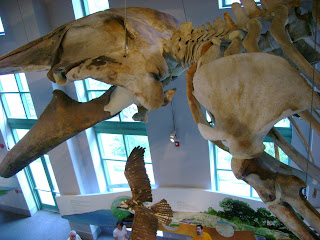
We went to the Museum of Natural Sciences, you can see the
real whale skeleton on display with free admission. It is very interesting, hope you will enjoy it too.


 A Real Trouble Story
This Sperm Whale washed ashore at Wrightsville Beach in 1928 and soon began decaying. It raised a stink that cleared the beach, becoming a health hazard as well as a public nuisance. Locals gave the whale nickname “Trouble,” :-D and it lived up to its name - particularly for the Museum, which wanted the whale’s skeleton for display. Moving the whale wasn’t an easy task. First the 54-foot, 100,000 pound whale had to be towed to an uninhabited beach. Towing cables broke and the wale was nearly lost in the rough sea. Once onshore, the whale washed off the beach and onto a nearby shoal where it stayed until stripped of most of its flesh. The bones were buried for a total of 16 months so that natural processes could remove the rest of its flesh…

 More Trouble
Trouble’s bones were buried on the beach for six months and again at the Fairgrounds for ten months. Natural processes removed the last remnants of rotting flesh.

 What Is Sperm Whale?
Capable of hour-long dives more than a mile deep, Sperm Whales are deep-sea dwellers and are seldom seen inshore unless stranded. They use specialized teeth to capture food but not to chew it – these whales swallow squid, sharks, fish, and other marine animals whole.

See how large the whale size compared to human beings



 Bones may tell us what dinosaurs look like, but the tracks tell us how they behaved. Look at the tracks drawn from a real trackway found in Texas.


.jpg)


